A26 · HSF.IF.A.1
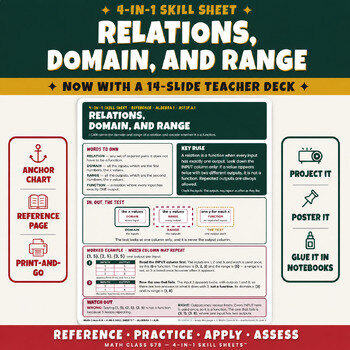
Relations, Domain, and Range
I can name the domain and range of a relation and decide whether it is a function.
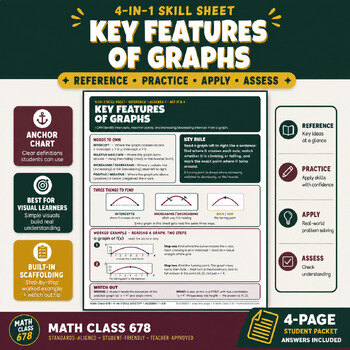
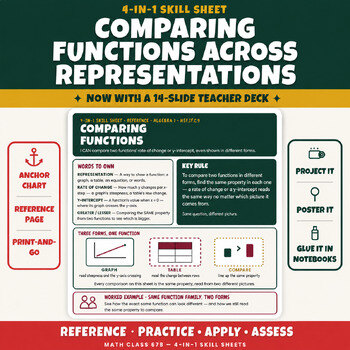
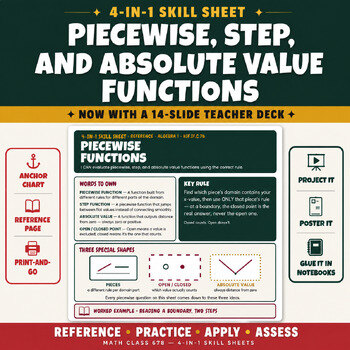
See the sheet8 skill sheets, one skill each: Relations, Domain, and Range, Identifying Functions from Mapping Diagrams, Function Notation, Evaluating Functions, Writing a Function Rule from a Table, Key Features of Graphs, Comparing Functions Across Representations, Piecewise, Step, and Absolute Value Functions.
Built to HSF.IF.A.1, HSF.IF.A.2, HSF.BF.A.1, HSF.IF.B.4, HSF.IF.C.9, HSF.IF.C.7b.
I can name the domain and range of a relation and decide whether it is a function.
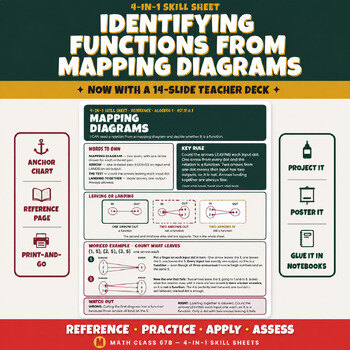
See the sheetI can read a relation from a mapping diagram and decide whether it is a function.
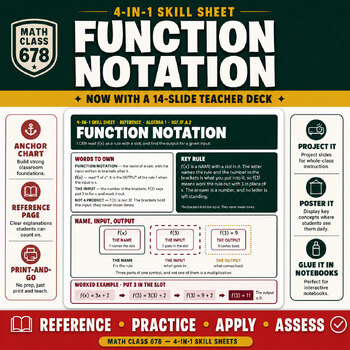
See the sheetI can read f(x) as a rule with a slot, and find the output for a given input.
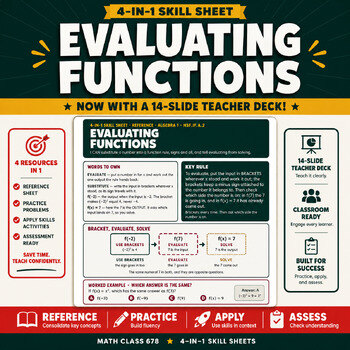
See the sheetI can substitute a number into a function rule, signs and all, and tell evaluating from solving.
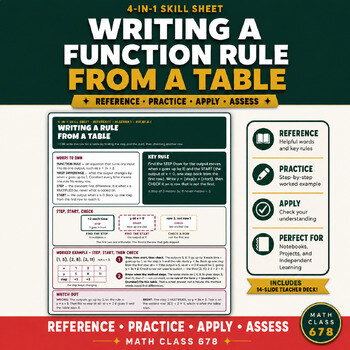
See the sheetI can write the rule for a table by finding the step and the start, then checking another row.
See the sheetI can identify intercepts, max/min points, and increasing/decreasing intervals from a graph.
See the sheetI can compare two functions' rate of change or y-intercept, even shown in different forms.
See the sheetI can evaluate piecewise, step, and absolute value functions using the correct rule.
See the sheetAll 8 Introduction to Functions skill sheets, with every answer key.
Standard codes refer to the Common Core State Standards for Mathematics. Math Class 678 is an independent publisher, not affiliated with, sponsored by, or endorsed by NGA Center or CCSSO. Every product is sold on Teachers Pay Teachers.
Sign up and I'll send you Combining Like Terms for 6th grade — a complete 4-in-1 Skill Sheet, no strings attached. You'll also hear when new sheets publish and when the store runs a sale.