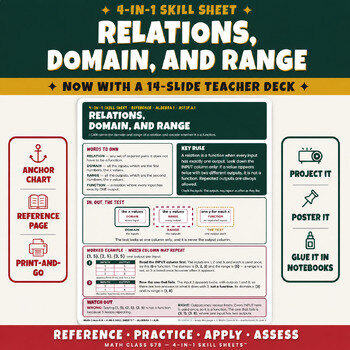
Relations, Domain, and Range
I can name the domain and range of a relation and decide whether it is a function.
The problem this sheet solves
The condition runs ONE WAY and they hear it as two. So they look at (1, 5), (2, 5), (3, 5), see the 5 three times, and rule it out — when every input is used exactly once and it is a perfectly good function. The worst part is that this misconception passes most quizzes: a student holding it still gets every failing relation right, so it survives until the unit is built on top of it. This sheet puts the two cases side by side on the reference page — one relation repeating an OUTPUT, one repeating an INPUT — because neither teaches anything alone. Every table figure plants a repeated output on purpose, so no item can be answered by scanning for duplicates, and the grading guide names the items that CANNOT detect the misconception so they are never marked on their own.
The key rule
A relation is a function when every input has exactly one output. Look down the INPUT column only: if a value appears twice with two different outputs, it is not a function. Repeated outputs are always allowed.
Check the inputs. The outputs may repeat as often as they like.
Watch out
The mistake: Saying (1, 5), (2, 5), (3, 5) is not a function because 5 keeps repeating.
The fix: Outputs may repeat freely. Every INPUT here is used once, so it IS a function. The one that fails is (3, 1), (3, 8), where one input has two outputs.
What is included
- Reference page — student-friendly definitions, a worked example, a Watch Out error pair, and the key rule
- Practice page — six problems, building from foundational to multi-step
- Apply page — a word problem, a reasoning prompt, and an error-analysis task
- Assess — a half-page exit ticket, two to a sheet, with a score box
- Full answer key — every item worked, plus a grading guide that says what each wrong answer tells you
- Ink-saver edition of all 7 pages
- 14-slide teacher deck (PowerPoint) with presenter notes on every slide
Standard codes refer to the Common Core State Standards for Mathematics. Math Class 678 is an independent publisher, not affiliated with, sponsored by, or endorsed by NGA Center or CCSSO. Every product is sold on Teachers Pay Teachers.