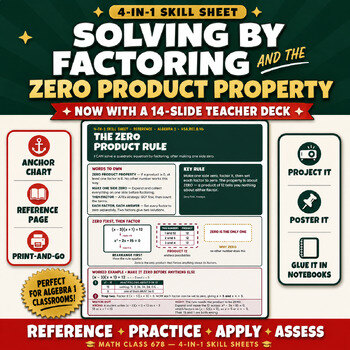
Solving by Factoring and the Zero Product Property
I can solve a quadratic equation by factoring, after making one side zero.
The problem this sheet solves
The zero product property is about ZERO and nothing else. Two numbers multiplying to 6 can be 2 and 3, or 12 and one half, or any of infinitely many pairs — only zero forces one factor to be zero. Students apply the shape of the method without the condition that makes it work. The sheet makes the condition the content: it asks what pairs multiply to 6, so the student produces the counterexample themselves rather than being told the rule has a catch. Items are chosen so that a student who solves the un-zeroed equation gets a value that visibly fails a substitution, which turns the check into the correction.
The key rule
Make one side zero, factor it, then set each factor to zero. The property is about ZERO — a product of 12 tells you nothing about either factor.
Zero first. Always.
Watch out
The mistake: A student writes (x − 3)(x + 1) = 12 as x − 3 = 12 or x + 1 = 12.
The fix: The rule needs the product to be ZERO. Expand and move the 12 across: x2 − 2x − 15 = 0, which factors as (x − 5)(x + 3), so x = 5 or x = −3. Their 15 and 11 are both wrong.
What is included
- Reference page — student-friendly definitions, a worked example, a Watch Out error pair, and the key rule
- Practice page — six problems, building from foundational to multi-step
- Apply page — a word problem, a reasoning prompt, and an error-analysis task
- Assess — a half-page exit ticket, two to a sheet, with a score box
- Full answer key — every item worked, plus a grading guide that says what each wrong answer tells you
- Ink-saver edition of all 7 pages
- 14-slide teacher deck (PowerPoint) with presenter notes on every slide
Standard codes refer to the Common Core State Standards for Mathematics. Math Class 678 is an independent publisher, not affiliated with, sponsored by, or endorsed by NGA Center or CCSSO. Every product is sold on Teachers Pay Teachers.