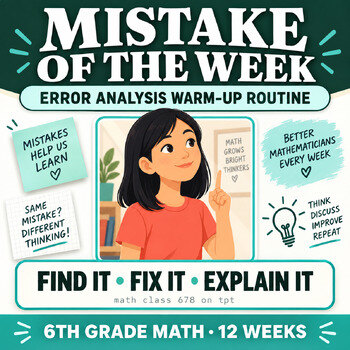
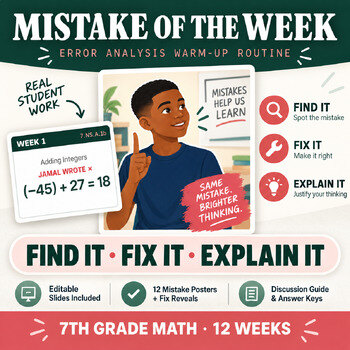
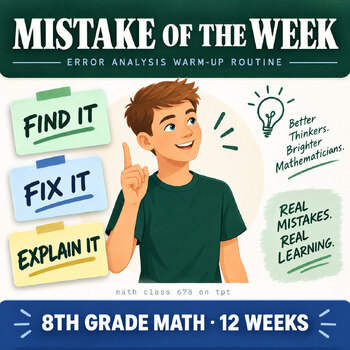
Find it. Fix it. Explain it.
One mistake poster on the wall each Monday. Your class has five minutes to find the one thing that went wrong, fix it and explain the rule in their own words, and on Friday two fresh Now You Try items check whether the fix stuck. Twelve weeks per grade, for 6th, 7th and 8th grade.
Try one with your class
Find the GCF of 24 and 36.
Maya says: “6 divides both, so the GCF is 6.”
6 does divide both. Is there a bigger number that also divides both?
Show the fix
The GCF is the largest factor the two numbers share, not simply a factor that works.
- List the common factors of 24 and 36: 1, 2, 3, 4, 6, 12.
- The greatest one on that list is 12.
- GCF(24, 36) = 12.
Twelve weeks per grade
Every grade runs the same five-minute Monday routine, so students arrive in 7th and 8th grade already knowing how to find, fix and explain a mistake.
Posters, reveals, checks and slides
- 12 mistake posters and 12 fix reveals, in color and black-and-white ink-saver versions
- 24 Now You Try check items with a full answer key
- A 51-slide editable PowerPoint deck plus a Google Slides copy link
- Response slips, a student Mistake Log, a 3-point rubric and sentence stems
- A pacing map with CCSS codes and a 3-panel bulletin board banner
What each grade’s mistakes cover
Each week’s skill and standard, and the 4-in-1 Skill Sheet to reteach it when the mistake shows up in your class.
12 weeks of 6th grade mistakes
One skill a week, each tied to the 4-in-1 Skill Sheet that teaches it
| Week | Skill | Standard | Skill Sheet |
|---|---|---|---|
| 1 | Greatest Common Factor | 6.NS.B.4 | Greatest Common Factor |
| 2 | Least Common Multiple | 6.NS.B.4 | Least Common Multiple |
| 3 | Dividing Fractions | 6.NS.A.1 | Dividing Fractions by Fractions |
| 4 | Multiplying Decimals | 6.NS.B.3 | Multi-Digit Operations |
| 5 | Understanding Ratios | 6.RP.A.1 | Understanding Ratios |
| 6 | Unit Rates | 6.RP.A.2 | Unit Rate Concept |
| 7 | Percent of a Number | 6.RP.A.3c | Ratio Reasoning Application |
| 8 | Exponents | 6.EE.A.1 | Exponents |
| 9 | Combining Like Terms | 6.EE.A.3 | Combining Like Terms |
| 10 | One-Step Equations | 6.EE.B.7 | Solving One-Step Equations |
| 11 | Area of a Triangle | 6.G.A.1 | Area of Polygons |
| 12 | Volume with Fractional Edges | 6.G.A.2 | Volume with Fractional Edge Lengths |
12 weeks of 7th grade mistakes
One skill a week, each tied to the 4-in-1 Skill Sheet that teaches it
| Week | Skill | Standard | Skill Sheet |
|---|---|---|---|
| 1 | Adding Integers | 7.NS.A.1b | Adding Integers |
| 2 | Subtracting Integers | 7.NS.A.1c | Subtracting Integers |
| 3 | Multiplying Integers | 7.NS.A.2a | Multiplying Integers |
| 4 | Dividing Integers | 7.NS.A.2b | Dividing Integers |
| 5 | Subtracting Mixed Numbers | 7.NS.A.1d | Adding & Subtracting Rationals |
| 6 | Multiplying Mixed Numbers | 7.NS.A.2c | Multiplying & Dividing Rationals |
| 7 | Decimals to Percents | 7.RP.A.3 | Percent Problems |
| 8 | Combining Like Terms | 7.EE.A.1 | Combining Like Terms |
| 9 | Distributive Property | 7.EE.A.1 | Distributive Property |
| 10 | Distribute and Combine | 7.EE.A.1 | Rewriting Expressions |
| 11 | Two-Step Equations | 7.EE.B.4a | Two-Step Equations |
| 12 | Two-Step Inequalities | 7.EE.B.4b | Two-Step Inequalities |
12 weeks of 8th grade mistakes
One skill a week, each tied to the 4-in-1 Skill Sheet that teaches it
| Week | Skill | Standard | Skill Sheet |
|---|---|---|---|
| 1 | Properties of Exponents | 8.EE.A.1 | Exponent Rules |
| 2 | Square Roots and Solutions | 8.EE.A.2 | Square & Cube Roots |
| 3 | Operations with Scientific Notation | 8.EE.A.4 | Operations with Scientific Notation |
| 4 | Rational vs. Irrational Numbers | 8.NS.A.1 | Rational vs Irrational Numbers |
| 5 | Multi-Step Equations | 8.EE.C.7 | Multi-Step Equations |
| 6 | Comparing Slopes | 8.EE.B.5 | Proportional Relationships (Graphing) |
| 7 | Slope from Two Points | 8.EE.B.6 | Slope-Intercept Form |
| 8 | Systems of Equations | 8.EE.C.8 | Systems by Substitution |
| 9 | Identifying Functions | 8.F.A.1 | Functions Definition |
| 10 | Rate of Change from a Table | 8.F.B.4 | Constructing Linear Functions |
| 11 | The Pythagorean Theorem | 8.G.B.7 | Pythagorean Theorem |
| 12 | Volume of a Sphere | 8.G.C.9 | Volume of Cones, Cylinders, Spheres |
One routine in every room
The bundle adds a 95-page all-grades teacher file: a department guide with a 6–8 vertical map of where each strand’s mistakes connect, a rollout plan and a 15-minute PLC protocol for sorting student slips.
Mistake of the Week questions
How long does it take each week?
Five minutes on Monday: students find the mistake, fix it and explain the rule in their own words. On Friday, two fresh Now You Try items check whether the fix stuck.
Why teach with wrong answers?
Students who can follow a worked example still repeat the same few mistakes on every quiz, because nobody asked them to look at a wrong answer and say why it is wrong. Explaining an error is also what constructed-response questions ask for when they say critique the reasoning.
Does it work in Google Slides?
Yes. Every grade has a 51-slide editable PowerPoint deck and a Google Slides copy link.
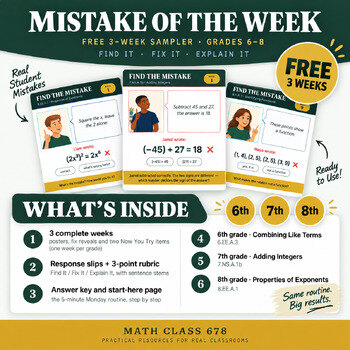
Can I try it first?
Yes. The free 3-week sampler has one complete week each for 6th, 7th and 8th grade, with response slips, a rubric and an answer key.
Standard codes refer to the Common Core State Standards for Mathematics. Math Class 678 is an independent publisher, not affiliated with, sponsored by, or endorsed by NGA Center or CCSSO. Every product is sold on Teachers Pay Teachers.