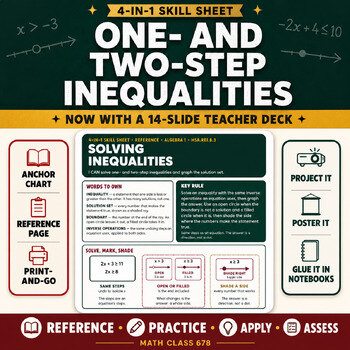
One- and Two-Step Inequalities
I can solve one- and two-step inequalities and graph the solution set.
The problem this sheet solves
A student solves 2x + 3 ≤ 11 perfectly and writes x = 4. Every step is right and the whole idea is missing: an equation's answer is a point, an inequality's answer is a region. This sheet spends its Watch Out, its Reasoning item and its conceptual exit-ticket question on that one confusion, and Practice 5 runs backwards from a graph to an inequality, which is the direction tests ask for and most worksheets skip. Every coefficient is positive on purpose, so nothing reverses direction yet.
The key rule
Solve an inequality with the same inverse operations an equation uses, then graph the answer. Use an open circle when the boundary is not a solution and a filled circle when it is, then shade the side where the numbers make the statement true.
Same steps as an equation. The answer is a direction, not a dot.
Watch out
The mistake: Solving 2x + 3 ≤ 11 correctly and then writing the answer as x = 4.
The fix: The answer is x ≤ 4. Four is where the solutions stop, not the only one: 3, 0 and −100 all work too, which is why the answer is a ray and not a point.
What is included
- Reference page — student-friendly definitions, a worked example, a Watch Out error pair, and the key rule
- Practice page — six problems, building from foundational to multi-step
- Apply page — a word problem, a reasoning prompt, and an error-analysis task
- Assess — a half-page exit ticket, two to a sheet, with a score box
- Full answer key — every item worked, plus a grading guide that says what each wrong answer tells you
- Ink-saver edition of all 7 pages
- 14-slide teacher deck (PowerPoint) with presenter notes on every slide
Standard codes refer to the Common Core State Standards for Mathematics. Math Class 678 is an independent publisher, not affiliated with, sponsored by, or endorsed by NGA Center or CCSSO. Every product is sold on Teachers Pay Teachers.