Linear-Quadratic Systems
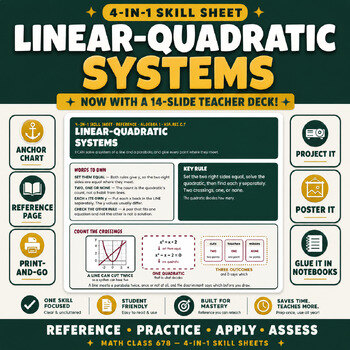
I can solve a system of a line and a parabola, and give every point where they meet.
The problem this sheet solves
The habit was TRUE for a whole unit: two lines cross once unless they are parallel or identical. Setting a line equal to a quadratic produces a QUADRATIC equation, and a quadratic has two solutions, one, or none. A second fault belongs only to having two points: the y is computed once and reused, so both x values get the same partner. The count is given as a consequence rather than a new rule, which also hands students the discriminant as a way to count the crossings before anything is drawn. One item has a horizontal line where both crossings genuinely DO share a y, so each x has its own y stays a rule rather than becoming a slogan. Substituting a point into the other equation is set up as the free check.
The key rule
Set the two right sides equal, solve the quadratic, then find each y separately. Two crossings, one, or none.
The quadratic decides how many.
Watch out
The mistake: A student solves, gets x = 2 and x = −1, and answers (2, 4).
The fix: Both x values are solutions, so there are two crossing points. Put each one back in the line on its own: (2, 4) and (−1, 1).
What is included
- Reference page — student-friendly definitions, a worked example, a Watch Out error pair, and the key rule
- Practice page — six problems, building from foundational to multi-step
- Apply page — a word problem, a reasoning prompt, and an error-analysis task
- Assess — a half-page exit ticket, two to a sheet, with a score box
- Full answer key — every item worked, plus a grading guide that says what each wrong answer tells you
- Ink-saver edition of all 7 pages
- 14-slide teacher deck (PowerPoint) with presenter notes on every slide
Standard codes refer to the Common Core State Standards for Mathematics. Math Class 678 is an independent publisher, not affiliated with, sponsored by, or endorsed by NGA Center or CCSSO. Every product is sold on Teachers Pay Teachers.