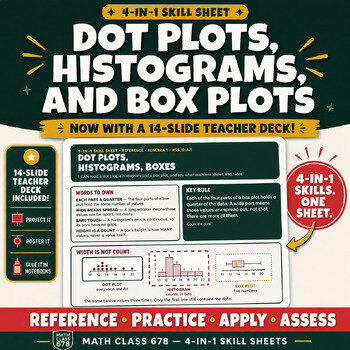
Dot Plots, Histograms, and Box Plots
I can read a dot plot, a histogram and a box plot, and say what each one shows and hides.
The problem this sheet solves
Width is read as count, and it is nearly universal the first time a class meets a box plot. A wide part means those values are spread far apart; a narrow part means they are packed together. Alongside it sits the other display students misread: a histogram is not a bar chart, its bars touch because the axis underneath is continuous, and its height is a COUNT. The data set was built to make the answer exact — twelve values, three in every quarter, and quarters 1.5, 1.0, 2.0 and 4.5 wide, so the widest part is over four times the narrowest and holds the same three values. The dot plot sits directly above the box plot on the same axis, so nothing is taken on trust: the dots inside the long whisker can be counted, and there are three.
The key rule
Each of the four parts of a box plot holds a quarter of the data. A wide part means those values are spread out, not that there are more of them.
Count the dots.
Watch out
The mistake: The right whisker is longest, so a student says most students took the longest.
The fix: Count them. The whisker holds 16, 18 and 20 — three values, the same as every other part. It is long because they are far apart.
What is included
- Reference page — student-friendly definitions, a worked example, a Watch Out error pair, and the key rule
- Practice page — six problems, building from foundational to multi-step
- Apply page — a word problem, a reasoning prompt, and an error-analysis task
- Assess — a half-page exit ticket, two to a sheet, with a score box
- Full answer key — every item worked, plus a grading guide that says what each wrong answer tells you
- Ink-saver edition of all 7 pages
- 14-slide teacher deck (PowerPoint) with presenter notes on every slide
Standard codes refer to the Common Core State Standards for Mathematics. Math Class 678 is an independent publisher, not affiliated with, sponsored by, or endorsed by NGA Center or CCSSO. Every product is sold on Teachers Pay Teachers.