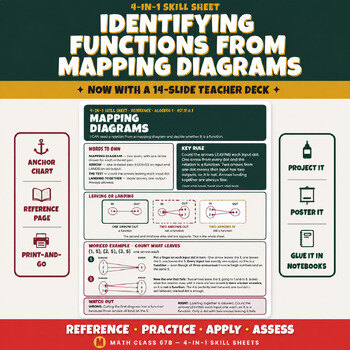
Identifying Functions from Mapping Diagrams
I can read a relation from a mapping diagram and decide whether it is a function.
The problem this sheet solves
Asked whether a relation is a function, half a class answers correctly and cannot say why. In a list of ordered pairs, "an input repeats" and "an output repeats" look almost identical, so a student who has learned the rule as nothing may repeat gets the same mark as one who understands it — until the unit is built on top of it and the difference starts costing them. A mapping diagram makes the two cases look nothing alike, and this sheet puts them side by side and refuses to let the verdict stand in for the reason. Every diagram plants a repeated OUTPUT deliberately, so no item can be answered by hunting for any repeat at all, and the grading guide names the items that CANNOT detect the misconception so they are never marked on their own.
The key rule
Count the arrows LEAVING each input dot. One arrow from every dot and the relation is a function. Two arrows from one dot means that input has two outputs, so it is not. Arrows landing together are always fine.
Count what leaves. Never count what lands.
Watch out
The mistake: Calling the first diagram ‘not a function’ because three arrows all land on the 5.
The fix: Landing together is allowed. Count the arrows LEAVING each input: one each, so it is a function. Only a dot with two arrows leaving it fails.
What is included
- Reference page — student-friendly definitions, a worked example, a Watch Out error pair, and the key rule
- Practice page — six problems, building from foundational to multi-step
- Apply page — a word problem, a reasoning prompt, and an error-analysis task
- Assess — a half-page exit ticket, two to a sheet, with a score box
- Full answer key — every item worked, plus a grading guide that says what each wrong answer tells you
- Ink-saver edition of all 7 pages
- 14-slide teacher deck (PowerPoint) with presenter notes on every slide
Standard codes refer to the Common Core State Standards for Mathematics. Math Class 678 is an independent publisher, not affiliated with, sponsored by, or endorsed by NGA Center or CCSSO. Every product is sold on Teachers Pay Teachers.