A79 · HSF.IF.C.7a
Graphing Quadratics in Standard Form
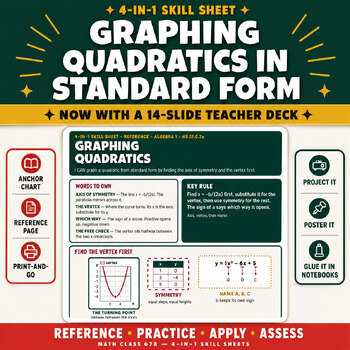
I can graph a quadratic from standard form by finding the axis of symmetry and the vertex first.
See the sheet7 skill sheets, one skill each: Graphing Quadratics in Standard Form, Key Features of Parabolas, Vertex Form and Transformations, Completing the Square to Find the Vertex, Factored Form and Zeros, Average Rate of Change for Quadratics, Modeling with Quadratic Functions.
Built to HSF.IF.C.7a, HSF.IF.B.4, HSF.BF.B.3, HSF.IF.C.8a, HSA.APR.B.3, HSF.IF.B.6, HSF.BF.A.1a.
I can graph a quadratic from standard form by finding the axis of symmetry and the vertex first.
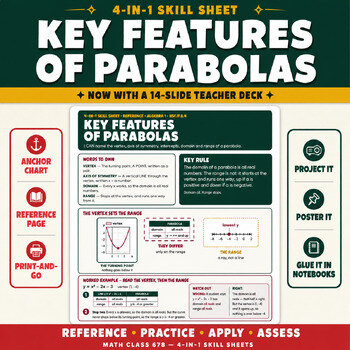
See the sheetI can name the vertex, axis of symmetry, intercepts, domain and range of a parabola.
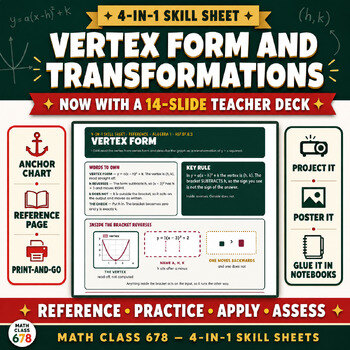
See the sheetI can read the vertex from vertex form and describe the graph as a transformation of y = x squared.
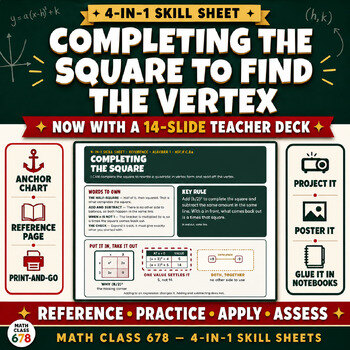
See the sheetI can complete the square to rewrite a quadratic in vertex form and read off the vertex.
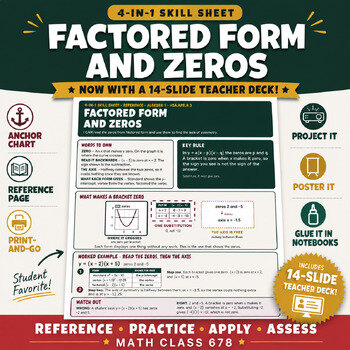
See the sheetI can read the zeros from factored form and use them to find the axis of symmetry.
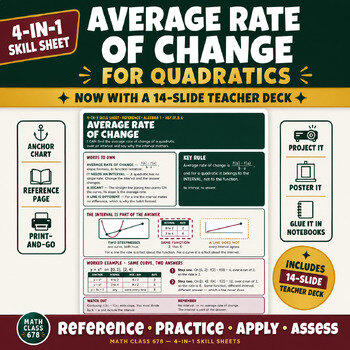
See the sheetI can find the average rate of change of a quadratic over an interval and say why the interval matters.
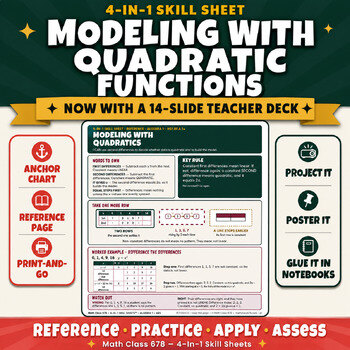
See the sheetI can use second differences to decide whether data is quadratic and to build the model.
See the sheetAll 7 Quadratic Functions skill sheets, with every answer key.
Standard codes refer to the Common Core State Standards for Mathematics. Math Class 678 is an independent publisher, not affiliated with, sponsored by, or endorsed by NGA Center or CCSSO. Every product is sold on Teachers Pay Teachers.
Sign up and I'll send you Combining Like Terms for 6th grade — a complete 4-in-1 Skill Sheet, no strings attached. You'll also hear when new sheets publish and when the store runs a sale.