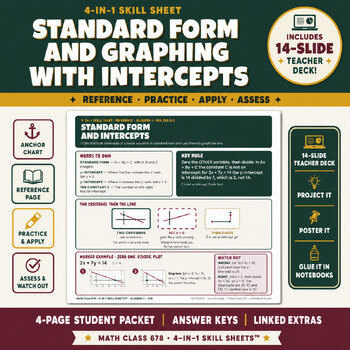
Standard Form and Graphing with Intercepts
I can find both intercepts of a linear equation in standard form and use them to graph the line.
The problem this sheet solves
In standard form the constant looks like an answer, so students read it as one. Finding an intercept means zeroing the OTHER variable and then DIVIDING, and it is the division that gets skipped. For 2x + 7y = 14 the y-intercept is 2, not 14, and nothing about the wrong answer looks unreasonable. This sheet makes zero the other variable, then divide a single two-part move, so the division is never optional. Graphing from intercepts is treated as the reason standard form is worth having, which gives the form a purpose rather than making it another format to memorise.
The key rule
Zero the OTHER variable, then divide. In Ax + By = C the constant C is not an intercept: for 2x + 7y = 14 the y-intercept is 14 ÷ 7, which is 2, not 14.
C is not an intercept. Divide first.
Watch out
The mistake: For 3x + 5y = 30, a student says the y-intercept is 30.
The fix: Set x = 0, then divide: 5y = 30, so y = 6. The intercepts are (10, 0) and (0, 6). Neither one is 30.
What is included
- Reference page — student-friendly definitions, a worked example, a Watch Out error pair, and the key rule
- Practice page — six problems, building from foundational to multi-step
- Apply page — a word problem, a reasoning prompt, and an error-analysis task
- Assess — a half-page exit ticket, two to a sheet, with a score box
- Full answer key — every item worked, plus a grading guide that says what each wrong answer tells you
- Ink-saver edition of all 7 pages
- 14-slide teacher deck (PowerPoint) with presenter notes on every slide
Standard codes refer to the Common Core State Standards for Mathematics. Math Class 678 is an independent publisher, not affiliated with, sponsored by, or endorsed by NGA Center or CCSSO. Every product is sold on Teachers Pay Teachers.