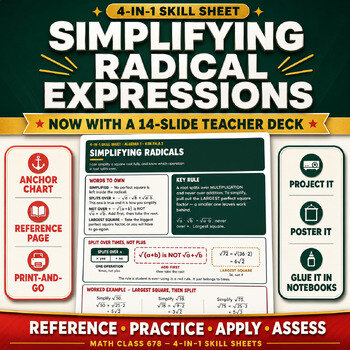
Simplifying Radical Expressions
I can simplify a square root fully, and know which operation a root splits over.
The problem this sheet solves
A root splits over MULTIPLICATION and never over addition. Because splitting is legal and familiar, students extend it to sums and get an answer that feels rule-governed. The second issue is stopping early: pulling out a perfect square factor that is not the LARGEST one leaves a radical that still simplifies. This sheet contrasts the legal split with the illegal one directly, so students see the boundary rather than a prohibition, and it insists on the largest perfect square factor so simplifying finishes in one pass. Numerical checks are built in, since 7 against 5 settles the argument faster than any restatement of the rule.
The key rule
A root splits over MULTIPLICATION and never over addition. To simplify, pull out the LARGEST perfect square factor — a smaller one leaves work behind.
Splits over ×, never over +. Largest square.
Watch out
The mistake: A student writes √(9 + 16) = √9 + √16 = 7.
The fix: √(9 + 16) = √25 = 5. Add first. Splitting is legal over MULTIPLICATION — √(9 · 16) really is 3 · 4 = 12 — so the rule being over-used is a real one, which is why 7 does not feel wrong.
What is included
- Reference page — student-friendly definitions, a worked example, a Watch Out error pair, and the key rule
- Practice page — six problems, building from foundational to multi-step
- Apply page — a word problem, a reasoning prompt, and an error-analysis task
- Assess — a half-page exit ticket, two to a sheet, with a score box
- Full answer key — every item worked, plus a grading guide that says what each wrong answer tells you
- Ink-saver edition of all 7 pages
- 14-slide teacher deck (PowerPoint) with presenter notes on every slide
Standard codes refer to the Common Core State Standards for Mathematics. Math Class 678 is an independent publisher, not affiliated with, sponsored by, or endorsed by NGA Center or CCSSO. Every product is sold on Teachers Pay Teachers.