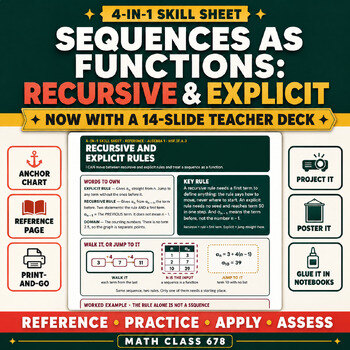
Sequences as Functions: Recursive and Explicit
I can move between recursive and explicit rules and treat a sequence as a function.
The problem this sheet solves
Students write an = a-sub-n-minus-1 + 4 and consider the sequence defined. But 3, 7, 11 and 10, 14, 18 both obey it exactly. A recursive rule says how to MOVE and never where to start, and the missing first term is treated as a formatting detail rather than half the definition. This sheet treats sequences as functions of position and puts the two rule types side by side, so students can see that a recursive rule needs a starting value and an explicit rule reaches any term in one step. The first term is required every time, and students produce two different sequences from one recursive rule to prove why.
The key rule
A recursive rule needs a first term: it says how to MOVE, never where to start. An explicit rule needs none, and reaches any term in one step.
Recursive = rule + first term. Explicit = jump straight there.
Watch out
The mistake: A student writes an = an − 1 + 4 and says that is the sequence.
The fix: It is infinitely many sequences. Both 3, 7, 11, 15 and 10, 14, 18, 22 obey it exactly. The rule says how to MOVE; a first term says where to stand. Write a1 = 3, and an = an − 1 + 4.
What is included
- Reference page — student-friendly definitions, a worked example, a Watch Out error pair, and the key rule
- Practice page — six problems, building from foundational to multi-step
- Apply page — a word problem, a reasoning prompt, and an error-analysis task
- Assess — a half-page exit ticket, two to a sheet, with a score box
- Full answer key — every item worked, plus a grading guide that says what each wrong answer tells you
- Ink-saver edition of all 7 pages
- 14-slide teacher deck (PowerPoint) with presenter notes on every slide
Standard codes refer to the Common Core State Standards for Mathematics. Math Class 678 is an independent publisher, not affiliated with, sponsored by, or endorsed by NGA Center or CCSSO. Every product is sold on Teachers Pay Teachers.