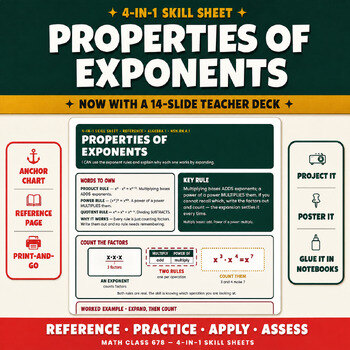
Properties of Exponents
I can use the exponent rules and explain why each one works by expanding.
The problem this sheet solves
Multiplying bases ADDS exponents; a power of a power MULTIPLIES them. Because both operations exist and both are taught in the same week, students pick by feel and multiplying usually wins. The answer looks like a rule was applied, which is why it survives correction that only says be careful. This sheet settles the choice by EXPANSION: write the factors out and count them, and the right rule becomes obvious without recall. That gives students something to fall back on in a test when the rules have blurred, and the sheet deliberately places the product and power rules side by side so the decision has to be made every time.
The key rule
Multiplying bases ADDS exponents; a power of a power MULTIPLIES them. If you cannot recall which, write the factors out and count — the expansion settles it every time.
Multiply bases: add. Power of a power: multiply.
Watch out
The mistake: A student writes x3 · x4 = x12, multiplying the exponents.
The fix: x3 · x4 = x7. Three x's beside four x's is seven x's. Multiplying is the POWER rule: (x3)4 really is x12. Both rules exist; only one fits this operation.
What is included
- Reference page — student-friendly definitions, a worked example, a Watch Out error pair, and the key rule
- Practice page — six problems, building from foundational to multi-step
- Apply page — a word problem, a reasoning prompt, and an error-analysis task
- Assess — a half-page exit ticket, two to a sheet, with a score box
- Full answer key — every item worked, plus a grading guide that says what each wrong answer tells you
- Ink-saver edition of all 7 pages
- 14-slide teacher deck (PowerPoint) with presenter notes on every slide
Standard codes refer to the Common Core State Standards for Mathematics. Math Class 678 is an independent publisher, not affiliated with, sponsored by, or endorsed by NGA Center or CCSSO. Every product is sold on Teachers Pay Teachers.