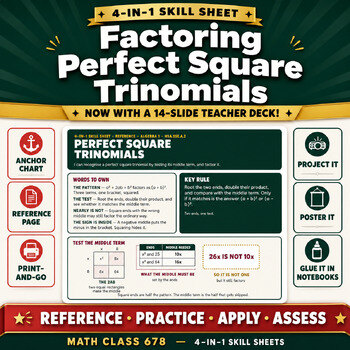
Factoring Perfect Square Trinomials
I can recognise a perfect square trinomial by testing its middle term, and factor it.
The problem this sheet solves
The perfect-square pattern has three conditions and students verify two of them. What makes this hard to correct is that the expression DOES factor, as (x plus 1)(x plus 25), so the right answer is not it does not factor. It is it factors, just not as a square. An item that was simply prime would teach the wrong lesson — that failing the perfect-square test means failing altogether, when it only means falling back to ordinary trinomial factoring. This sheet builds the distinction in deliberately, and names the arc it sits in: each special form has one condition students drop, the sign for a difference of squares and the middle term here.
The key rule
Root the two ends, double their product, and compare with the middle term. Only if it matches is the answer (a + b)² or (a − b)².
Two ends, one test.
Watch out
The mistake: A student writes x2 + 26x + 25 = (x + 5)2.
The fix: The ends do root to x and 5, but doubling gives 10x against a middle of 26x. Not a perfect square — though it factors, as (x + 1)(x + 25).
What is included
- Reference page — student-friendly definitions, a worked example, a Watch Out error pair, and the key rule
- Practice page — six problems, building from foundational to multi-step
- Apply page — a word problem, a reasoning prompt, and an error-analysis task
- Assess — a half-page exit ticket, two to a sheet, with a score box
- Full answer key — every item worked, plus a grading guide that says what each wrong answer tells you
- Ink-saver edition of all 7 pages
- 14-slide teacher deck (PowerPoint) with presenter notes on every slide
Standard codes refer to the Common Core State Standards for Mathematics. Math Class 678 is an independent publisher, not affiliated with, sponsored by, or endorsed by NGA Center or CCSSO. Every product is sold on Teachers Pay Teachers.