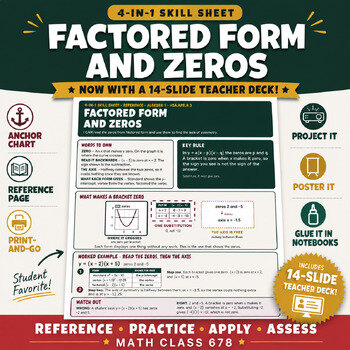
Factored Form and Zeros
I can read the zeros from factored form and use them to find the axis of symmetry.
The problem this sheet solves
A bracket is zero when x makes it zero, so (x minus 2) vanishes at plus 2. The sign shown is the sign of the subtraction, not of the answer. This is the fourth time in the course the same reversal appears, after point-slope form, function transformations and vertex form, and by now it deserves to be named as a pattern rather than met again as a surprise. The check is one substitution and it is unarguable: put 2 in and the first bracket is 0, so the product is 0, which is what a zero MEANS. Put minus 2 in and you get minus 12. Nothing has to be recalled. The sheet also says out loud why factored form is worth having — it is the only one of the three forms that shows the zeros without any work.
The key rule
In y = a(x − p)(x − q) the zeros are p and q. A bracket is zero when x makes it zero, so the sign you see is not the sign of the answer.
Substitute. It must give zero.
Watch out
The mistake: A student says y = (x − 2)(x + 5) has zeros −2 and 5.
The fix: 2 and −5. A bracket is zero when x makes it zero, and (x − 2) vanishes at x = +2. Substituting −2 gives (−4)(3) = −12, which is not zero.
What is included
- Reference page — student-friendly definitions, a worked example, a Watch Out error pair, and the key rule
- Practice page — six problems, building from foundational to multi-step
- Apply page — a word problem, a reasoning prompt, and an error-analysis task
- Assess — a half-page exit ticket, two to a sheet, with a score box
- Full answer key — every item worked, plus a grading guide that says what each wrong answer tells you
- Ink-saver edition of all 7 pages
- 14-slide teacher deck (PowerPoint) with presenter notes on every slide
Standard codes refer to the Common Core State Standards for Mathematics. Math Class 678 is an independent publisher, not affiliated with, sponsored by, or endorsed by NGA Center or CCSSO. Every product is sold on Teachers Pay Teachers.