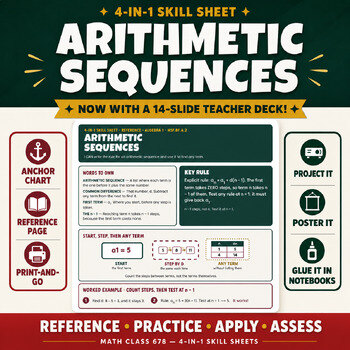
Arithmetic Sequences
I can write the rule for an arithmetic sequence and use it to find any term.
The problem this sheet solves
The first term takes ZERO steps, so reaching term n takes n − 1 of them, and the rule that leaves out the minus one is off by one everywhere. It is seductive because it is built from two correct numbers, the first term and the common difference, assembled in the obvious way. This sheet makes the step COUNT visible, showing the first term sitting above zero steps, which is the picture that makes n − 1 inevitable rather than memorised. Every rule is tested at n = 1, and that single check catches the error immediately, so students stop needing to recall the formula's shape.
The key rule
Explicit rule: an = a1 + d(n − 1). The first term takes ZERO steps, so term n takes n − 1 of them. Test any rule at n = 1: it must give back a1.
n − 1 steps, not n. Test it at n = 1.
Watch out
The mistake: For 5, 8, 11, 14, ... a student writes an = 5 + 3n.
The fix: an = 5 + 3(n − 1). Test at n = 1: the wrong rule gives 8, which is the SECOND term. It is one step out at every single n, not just the first.
What is included
- Reference page — student-friendly definitions, a worked example, a Watch Out error pair, and the key rule
- Practice page — six problems, building from foundational to multi-step
- Apply page — a word problem, a reasoning prompt, and an error-analysis task
- Assess — a half-page exit ticket, two to a sheet, with a score box
- Full answer key — every item worked, plus a grading guide that says what each wrong answer tells you
- Ink-saver edition of all 7 pages
- 14-slide teacher deck (PowerPoint) with presenter notes on every slide
Standard codes refer to the Common Core State Standards for Mathematics. Math Class 678 is an independent publisher, not affiliated with, sponsored by, or endorsed by NGA Center or CCSSO. Every product is sold on Teachers Pay Teachers.