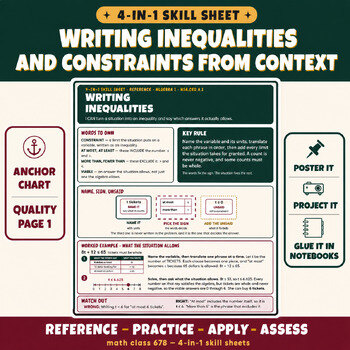
Writing Inequalities and Constraints from Context
I can turn a situation into an inequality and say which answers it actually allows.
The problem this sheet solves
Two errors, and only one of them looks like a mistake. The first is the sign: at most and at least include their number, more than and fewer than do not, and a student who writes t This sheet separates the constraints a problem STATES from the ones it takes for granted, and puts them in the same table so the difference is visible. The hidden rows are tinted AND labelled, so they survive a black-and-white printer. One item deliberately runs the other way — miles do not have to be whole — because a sheet that taught always round down would be worse than one that never raised viability at all.
The key rule
Name the variable and its units, translate each phrase in order, then add every limit the situation takes for granted. A count is never negative, and some counts must be whole.
The words fix the sign. The situation fixes the rest.
Watch out
The mistake: Writing t < 6 for ‘at most 6 tickets’.
The fix: ‘At most’ includes the number itself, so it is t ≤ 6. ‘More than 6’ is the phrase that excludes it.
What is included
- Reference page — student-friendly definitions, a worked example, a Watch Out error pair, and the key rule
- Practice page — six problems, building from foundational to multi-step
- Apply page — a word problem, a reasoning prompt, and an error-analysis task
- Assess — a half-page exit ticket, two to a sheet, with a score box
- Full answer key — every item worked, plus a grading guide that says what each wrong answer tells you
- Ink-saver edition of all 7 pages
- 14-slide teacher deck (PowerPoint) with presenter notes on every slide
Standard codes refer to the Common Core State Standards for Mathematics. Math Class 678 is an independent publisher, not affiliated with, sponsored by, or endorsed by NGA Center or CCSSO. Every product is sold on Teachers Pay Teachers.