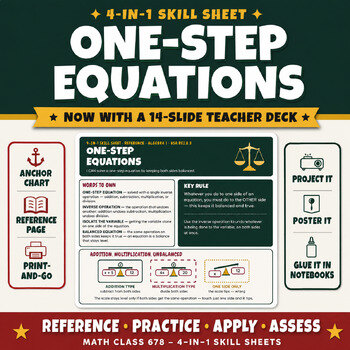
One-Step Equations
I can solve a one-step equation by keeping both sides balanced.
The problem this sheet solves
One-step equations are where the balance idea is either built or missed, and a student who operates on one side only is not being careless. They are treating the equals sign as a place where the answer goes rather than a claim that two quantities are equal. Left unaddressed it survives into every multi-step equation later in the course. This sheet makes the balance visible with a scale rather than asserting it, so doing the same thing to both sides has a reason behind it. Inverse operations are paired explicitly, and students are asked to substitute their answer back, which turns checking into part of solving instead of an optional extra step.
The key rule
Whatever you do to one side of an equation, you must do to the OTHER side — this keeps it balanced and true.
Use the inverse operation to undo whatever is being done to the variable, on both sides at once.
Watch out
The mistake: x + 5 = 12, subtracting 5 from the left only: x = 12 — the scale is no longer balanced.
The fix: Subtract 5 from BOTH sides: x + 5 − 5 = 12 − 5, so x = 7 — the scale stays level.
What is included
- Reference page — student-friendly definitions, a worked example, a Watch Out error pair, and the key rule
- Practice page — six problems, building from foundational to multi-step
- Apply page — a word problem, a reasoning prompt, and an error-analysis task
- Assess — a half-page exit ticket, two to a sheet, with a score box
- Full answer key — every item worked, plus a grading guide that says what each wrong answer tells you
- Ink-saver edition of all 7 pages
- 14-slide teacher deck (PowerPoint) with presenter notes on every slide
Standard codes refer to the Common Core State Standards for Mathematics. Math Class 678 is an independent publisher, not affiliated with, sponsored by, or endorsed by NGA Center or CCSSO. Every product is sold on Teachers Pay Teachers.