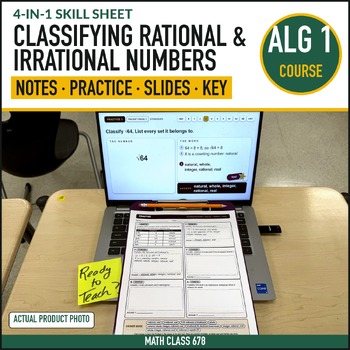
Classifying Real Numbers
I can classify a real number as natural, whole, integer, rational, and/or irrational.
What students learn
Students learn to simplify a number first, then name every set it belongs to: natural, whole, integer, rational or irrational, and real.
See inside
The key rule
Simplify first. Then find the narrowest set that holds the number, and name every set that contains it.
√81 = 9 → natural, whole, integer, rational, real
Every real number is rational or irrational, never both.
Watch out
Classify √25.
The mistake: √25 has a root sign: irrational, realA root sign alone does not decide it.
The fix: √25 = 5: natural, whole, integer, rational, real5 × 5 = 25. The square root of a whole number is irrational unless the number is a perfect square.
The mistakes it targets
- Calls a number irrational just because it has a root sign
- Treats any number with no fraction part, negatives included, as whole
- Calls every never-ending decimal irrational, even ones that repeat
- Counts 0 as a natural number
- Treats a decimal close to π, such as 3.14, as π itself
The interactive Teacher Deck (33 slides, PowerPoint)
- The Learn page taught on screen: 9 fill-in blanks, each filled on its own click as students write it
- The worked example one slide per step (five steps), each with the reason for the step
- Six practice and three apply problems: a your-turn slide with a think-time bar, then the solution one line per click
- Jump buttons on every slide: go straight to any problem, the answer bank or the exit ticket
- Speaker notes on each problem: the question to ask, the worked answer and the common error to listen for
- A completed deck PDF (19 pages) with every slide fully built, to print or post
The student packet (9 pages)
- Learn: guided notes with four definitions, the key rule, a worked example and a Watch Out error pair
- Practice: two warm-up, two standard and two stretch problems, with an answer bank for self-checking that hides three common-mistake decoys
- Apply: two word problems and one error analysis
- Assess: an exit ticket of four items, two per page, with an I-can self-rating
- Homework (page 5): eight new problems, two warm-up, four standard and two stretch
- Answer key (pages 6–7): every problem worked step by step, five common mistakes with what to do about each, and a grading guide, plus the homework key (page 8)
- Color and ink-saver editions of the whole packet
Standard codes refer to the Common Core State Standards for Mathematics. Math Class 678 is an independent publisher, not affiliated with, sponsored by, or endorsed by NGA Center or CCSSO. Every product is sold on Teachers Pay Teachers.